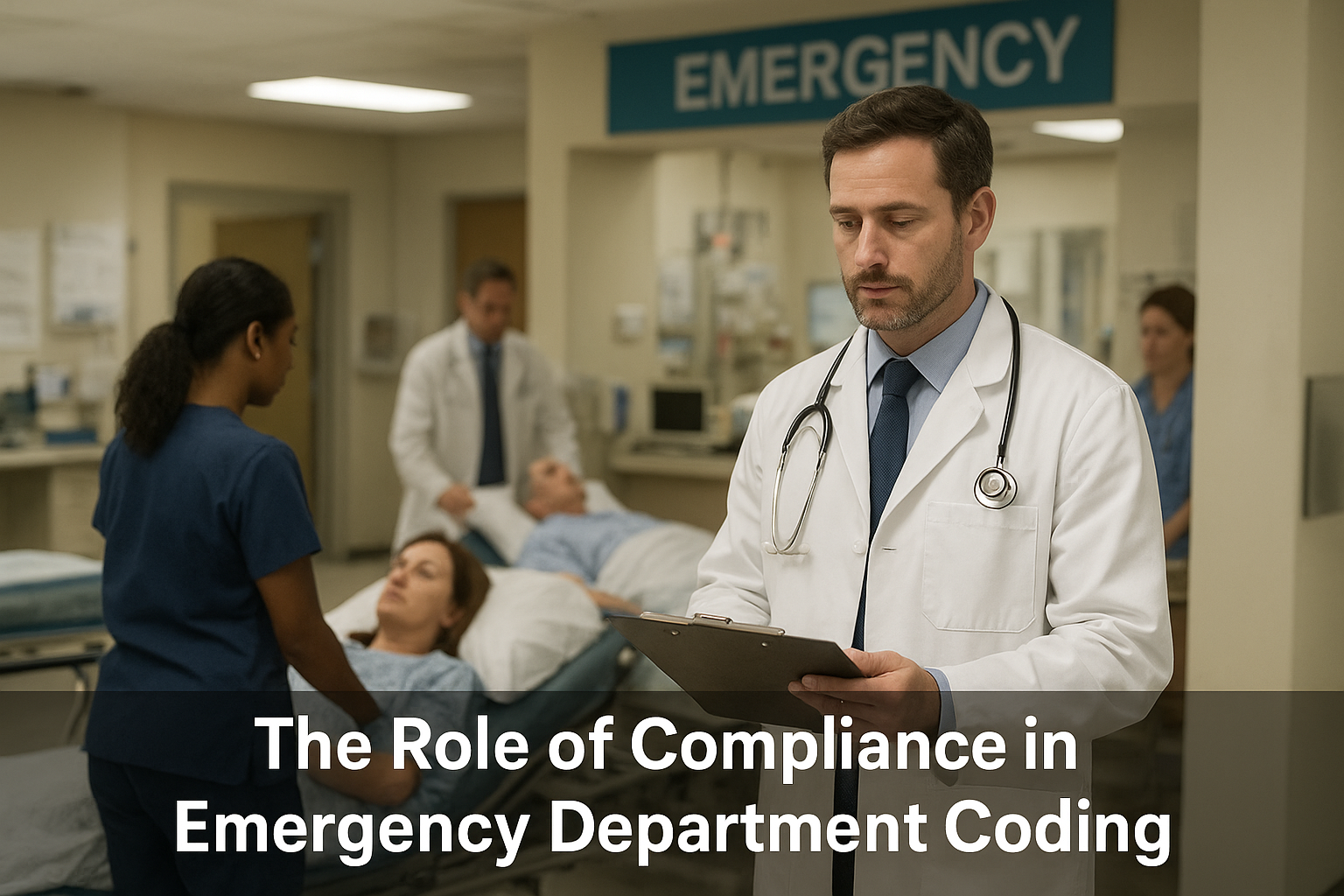
The Role of Compliance in Emergency Department Coding: Navigating Complexity in Critical Care Documentation
Emergency Department Coding
Emergency Department Coding
Emergency departments (EDs) represent one of the most challenging environments in healthcare, where life-and-death decisions happen at breakneck speed, and medical professionals must balance patient care with complex administrative requirements. Among these requirements, medical coding compliance stands as a critical component that directly impacts financial stability, regulatory adherence, and quality of care metrics. Understanding the intricate role of compliance in emergency department coding is essential for healthcare administrators, coding professionals, and clinical staff alike.

The Foundation of Emergency Department Coding
Emergency department coding operates under a unique set of circumstances that distinguish it from other healthcare settings. Unlike scheduled procedures or routine clinic visits, ED encounters are often unpredictable, urgent, and involve multiple decision points that can significantly impact coding outcomes. The complexity lies not only in the medical conditions treated but also in the documentation requirements, time constraints, and the need for real-time decision-making that affects both patient care and revenue cycle management.
The Centers for Medicare & Medicaid Services (CMS) and other regulatory bodies have established specific guidelines for ED coding that require meticulous attention to detail and comprehensive understanding of both clinical protocols and administrative requirements. These guidelines are designed to ensure accurate representation of services provided while preventing fraud and abuse in billing practices.
Regulatory Framework and Compliance Requirements
The regulatory landscape governing emergency department coding is multifaceted and constantly evolving. Key components include the Emergency Medical Treatment and Labor Act (EMTALA), which mandates that EDs provide medical screening examinations regardless of patients’ ability to pay, and various CMS guidelines that dictate proper coding and billing practices.
Compliance in ED coding must address several critical areas: proper use of evaluation and management (E/M) codes, accurate documentation of medical decision-making complexity, appropriate application of modifier codes, and adherence to National Correct Coding Initiative (NCCI) edits. Each of these areas presents unique challenges in the fast-paced emergency environment.
The recent updates to E/M coding guidelines have particularly impacted emergency departments, requiring coders and clinicians to adapt their documentation and coding practices to align with new requirements for medical decision-making documentation and time-based coding options. These changes have significant implications for compliance programs and require ongoing education and monitoring.
Documentation Challenges in Emergency Settings
One of the most significant compliance challenges in emergency department coding stems from documentation requirements. Emergency physicians must balance the immediate needs of patient care with the administrative necessity of creating comprehensive, compliant documentation that supports accurate coding.
The nature of emergency medicine often involves rapid assessment, quick decision-making, and immediate intervention, which can create gaps in documentation if proper protocols are not established. Compliance programs must address these challenges by implementing systems that support real-time documentation, provide clinical decision support, and ensure that all billable services are properly captured and documented.

Electronic health records (EHRs) have become instrumental in addressing documentation challenges, but they also present their own compliance risks. Issues such as copy-and-paste documentation, template overuse, and insufficient customization for emergency department workflows can lead to compliance violations and audit findings.
Risk Areas and Common Compliance Violations
Emergency departments face several high-risk areas for compliance violations that require constant vigilance and proactive management. One of the most common issues involves upcoding or downcoding of E/M services, often resulting from inadequate documentation or misunderstanding of coding guidelines.
Modifier usage presents another significant risk area, particularly with modifier 25 (significant, separately identifiable E/M service) and modifier 59 (distinct procedural service). Emergency departments frequently perform multiple procedures during a single encounter, making proper modifier application crucial for compliance and appropriate reimbursement.
Observation services coding represents a particularly complex area where compliance violations frequently occur. The distinction between observation services and inpatient admissions, proper documentation requirements for observation, and appropriate use of observation codes require specialized knowledge and careful attention to regulatory guidelines.
Bundling and unbundling issues also pose significant compliance risks, especially when emergency departments provide multiple related services during a single encounter. Understanding NCCI edits and proper coding relationships is essential for maintaining compliance while ensuring appropriate reimbursement for services provided.
Technology’s Role in Compliance Management
Modern compliance programs in emergency departments increasingly rely on technology solutions to identify, prevent, and correct coding errors. Computer-assisted coding (CAC) systems can help identify potential compliance issues in real-time, while analytics platforms can detect patterns that may indicate systematic problems.
Charge capture technology has become particularly important in emergency departments, where the fast-paced environment can lead to missed charges or incomplete documentation. Automated systems that integrate with EHRs can help ensure that all billable services are captured and properly coded.
Audit software and compliance monitoring tools enable healthcare organizations to conduct regular internal audits, identify trends, and implement corrective actions before external audits reveal problems. These tools are essential for maintaining ongoing compliance and demonstrating good faith efforts to regulatory bodies.

Staff Training and Education Programs
Effective compliance in emergency department coding requires comprehensive training programs that address the unique challenges of the ED environment. These programs must cover not only basic coding principles but also the specific regulatory requirements that apply to emergency services.
Ongoing education is crucial due to the constant evolution of coding guidelines, regulatory requirements, and best practices. Compliance programs must include regular training sessions, updates on regulatory changes, and competency assessments to ensure that all staff members maintain current knowledge and skills.
Cross-training between clinical and coding staff can significantly improve compliance outcomes by helping each group understand the requirements and challenges faced by the other. When physicians understand coding requirements and coders understand clinical workflows, the result is often improved documentation and more accurate coding.
Financial Impact of Compliance
The financial implications of compliance in emergency department coding extend far beyond avoiding penalties and audit findings. Proper compliance programs can significantly impact revenue cycle performance, cash flow, and overall financial stability.
Undercoding, often resulting from conservative coding practices intended to avoid compliance risks, can result in significant revenue losses. Conversely, overcoding can lead to audit findings, repayment demands, and potential fraud allegations. Effective compliance programs help organizations find the appropriate balance that ensures accurate coding while maximizing legitimate reimbursement.
The cost of compliance programs themselves must be considered, including staff time, technology investments, and ongoing education expenses. However, these costs are typically far outweighed by the benefits of avoiding audit findings, penalties, and the administrative burden associated with compliance violations.
Quality Metrics and Performance Monitoring
Compliance programs in emergency departments must include robust monitoring and measurement systems to track performance and identify areas for improvement. Key performance indicators (KPIs) should include coding accuracy rates, documentation completion metrics, denial rates, and audit findings.
Regular internal audits are essential for maintaining compliance and identifying potential issues before they become systemic problems. These audits should cover all aspects of ED coding, including E/M services, procedures, diagnoses, and modifier usage.
Benchmarking against industry standards and peer organizations can provide valuable insights into performance gaps and improvement opportunities. Many healthcare organizations participate in coding accuracy studies and industry surveys to better understand their performance relative to others.

Future Trends and Evolving Requirements
The landscape of emergency department coding compliance continues to evolve, driven by changes in healthcare delivery models, regulatory requirements, and technology capabilities. Telemedicine integration, value-based care initiatives, and artificial intelligence applications are reshaping how emergency departments operate and how coding compliance is managed.
Regulatory bodies continue to refine requirements and expectations for emergency department coding, with recent focus on appropriate documentation, medical necessity, and quality metrics. Staying ahead of these changes requires proactive monitoring of regulatory developments and continuous adaptation of compliance programs.
The integration of clinical decision support tools and artificial intelligence in coding processes presents both opportunities and challenges for compliance management. While these technologies can improve accuracy and efficiency, they also require new approaches to oversight and validation.
Conclusion
The role of compliance in emergency department coding is both critical and complex, requiring sophisticated programs that address the unique challenges of the emergency care environment. Success in this area demands a comprehensive approach that combines technology solutions, staff education, robust monitoring systems, and proactive adaptation to evolving requirements.
Healthcare organizations that invest in effective ED coding compliance programs position themselves for improved financial performance, reduced regulatory risk, and enhanced quality of care metrics. As the healthcare landscape continues to evolve, the importance of strong compliance programs in emergency departments will only continue to grow.
The key to successful compliance lies in recognizing that it is not merely an administrative requirement but an integral component of quality patient care and organizational sustainability. By maintaining focus on accurate documentation, appropriate coding practices, and continuous improvement, emergency departments can achieve compliance while supporting their primary mission of providing excellent patient care in critical situations.
Organizations that view compliance as a strategic advantage rather than a burden are more likely to succeed in the increasingly complex healthcare environment. Through careful attention to regulatory requirements, investment in appropriate technology and training, and commitment to continuous improvement, emergency departments can maintain high standards of compliance while delivering exceptional patient care.