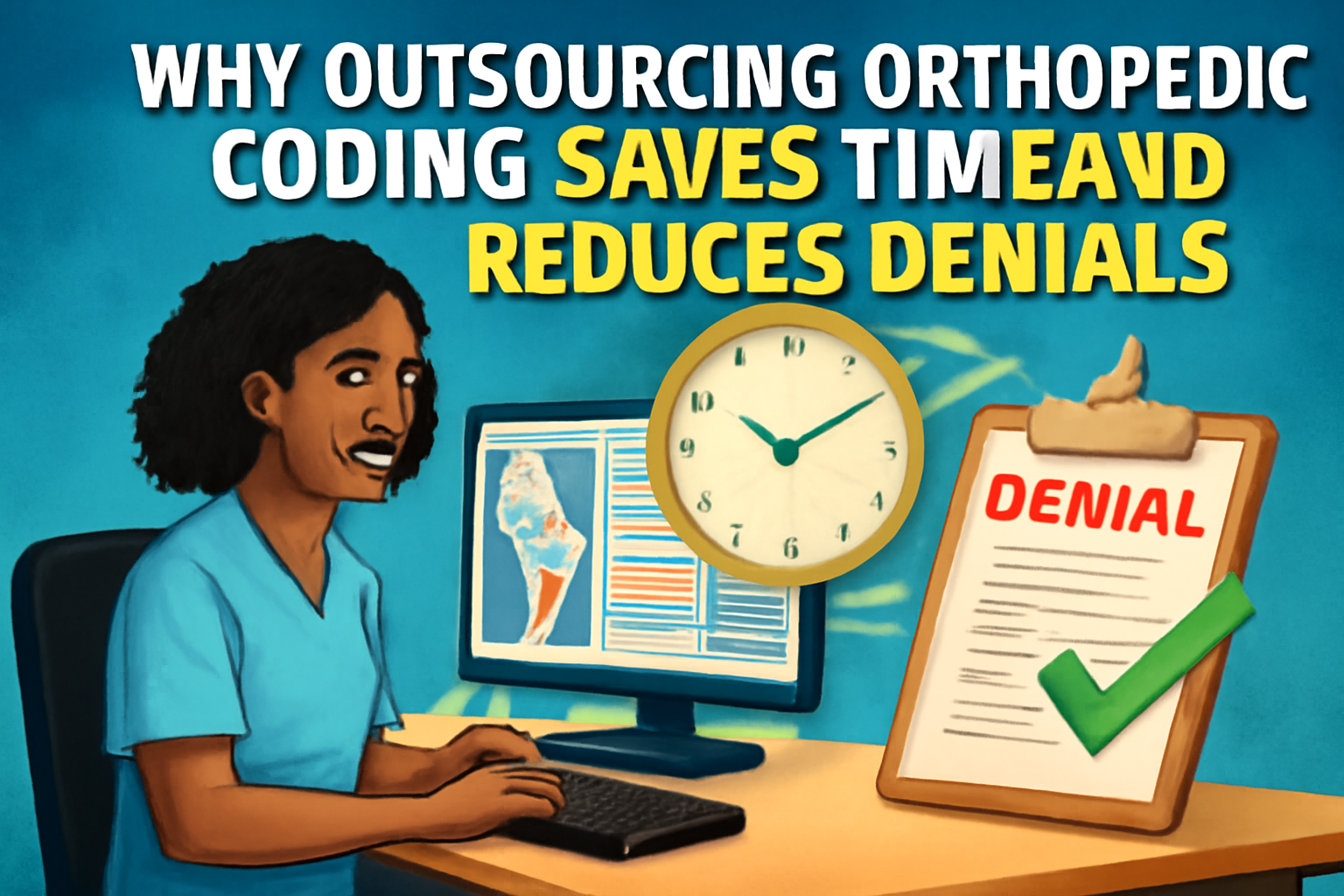
Why Outsourcing Orthopedic Coding Saves Time and Reduces Denials
Outsourcing Orthopedic Coding
Outsourcing Orthopedic Coding
In today’s complex healthcare landscape, orthopedic practices face mounting pressure to maximize efficiency while maintaining accurate billing and coding standards. With intricate procedures, evolving regulations, and the constant threat of claim denials, many practices are discovering that outsourcing their orthopedic coding offers a strategic solution that delivers both time savings and improved financial outcomes.

The Complexity Challenge of Orthopedic Coding
Orthopedic coding presents unique challenges that set it apart from other medical specialties. The field encompasses an extensive range of procedures, from routine arthroscopic surgeries to complex spinal reconstructions, each requiring precise documentation and coding expertise. The anatomical complexity alone demands coders who understand not just the procedural aspects but also the intricate relationships between bones, joints, muscles, and supporting structures.
Modern orthopedic practices must navigate an increasingly complex web of coding systems, including ICD-10-CM for diagnoses, CPT codes for procedures, and HCPCS codes for supplies and equipment. Each system contains hundreds of orthopedic-specific codes, with frequent updates and revisions that require constant attention and education. This complexity extends beyond simple code selection to include proper modifier usage, bundling and unbundling rules, and compliance with payer-specific requirements.
The stakes for accuracy couldn’t be higher. Orthopedic procedures often involve significant financial investments, with complex surgeries generating substantial revenue for practices. However, coding errors can result in denied claims, delayed payments, and in severe cases, audit penalties and compliance issues. The financial impact of even minor coding mistakes can quickly accumulate, making accuracy not just a quality measure but a critical business imperative.
Time Savings Through Specialized Expertise
When orthopedic practices outsource their coding functions, they immediately gain access to specialized expertise that would be costly and time-consuming to develop in-house. Professional coding companies employ certified coders who focus exclusively on orthopedic procedures, developing deep expertise that surpasses what most practices can maintain internally. These specialists understand the nuances of orthopedic coding, from the complexities of joint replacement procedures to the intricacies of trauma surgery documentation.
The time savings begin with the elimination of recruitment and training overhead. Building an internal coding team requires significant investment in hiring qualified personnel, providing ongoing education, and managing staff turnover. Orthopedic coding specialists are in high demand, and practices often struggle to attract and retain qualified candidates. Outsourcing partners have already made these investments, providing practices with immediate access to trained professionals without the associated hiring costs or training delays.
Professional coding services also bring established workflows and quality assurance processes that individual practices would need to develop from scratch. These organizations have refined their processes over years of operation, implementing best practices for code review, documentation improvement, and denial management. Rather than spending months or years developing these capabilities internally, practices can immediately benefit from proven systems and processes.
The scalability factor provides additional time savings as practices grow or experience volume fluctuations. Internal coding staff must be sized for peak capacity, leading to inefficiencies during slower periods or overwhelming backlogs during busy times. Outsourcing partners can adjust resources dynamically, ensuring consistent turnaround times regardless of volume variations. This flexibility eliminates the need for practices to constantly evaluate staffing levels and make difficult hiring or reduction decisions.
Dramatic Reduction in Claim Denials
Perhaps the most compelling benefit of outsourcing orthopedic coding lies in the significant reduction in claim denials. Professional coding services bring multiple layers of expertise and quality control that directly address the common causes of orthopedic claim denials. Their specialized knowledge helps prevent the coding errors that frequently trigger denials, while their systematic approach to documentation review catches potential issues before claims are submitted.
The expertise advantage manifests in several critical areas. Specialized orthopedic coders understand the complex bundling and unbundling rules that frequently trip up generalist coders. They know when multiple procedures performed during the same surgical session can be billed separately and when modifier usage is required to prevent automatic denials. This knowledge extends to payer-specific requirements, as professional coding services maintain current information about the varying policies and procedures of different insurance companies.

Documentation improvement represents another crucial factor in denial reduction. Experienced orthopedic coders can identify documentation deficiencies that may not be apparent to clinical staff but could lead to claim denials. They work proactively with practices to improve documentation quality, providing feedback that helps surgeons and support staff create records that support accurate coding and reduce denial risk. This collaborative approach creates a continuous improvement cycle that strengthens both coding accuracy and overall practice documentation.
Quality assurance processes implemented by professional coding services provide additional protection against denials. These typically include multiple review stages, with experienced coders checking the work of junior staff and specialized auditors performing regular quality assessments. Such comprehensive review processes catch errors that might slip through less structured internal systems, providing practices with confidence that their claims will be processed successfully on the first submission.
The data analytics capabilities of professional coding services also contribute to denial reduction. These organizations track denial patterns across multiple clients, identifying trends and emerging issues that individual practices might not recognize. This collective intelligence allows them to proactively address potential problems and adjust coding practices to prevent denials before they occur.
Financial Impact and ROI Analysis
The financial benefits of outsourcing orthopedic coding extend well beyond the obvious cost savings of avoiding internal staff expenses. While eliminating salaries, benefits, and training costs provides immediate savings, the more substantial financial impact comes from improved revenue cycle performance and reduced denial rates. These improvements compound over time, creating significant financial advantages that justify the outsourcing investment.
Revenue acceleration represents one of the most immediate financial benefits. Professional coding services typically process claims faster than internal staff, reducing the time between service delivery and payment receipt. This improvement in days sales outstanding has a direct impact on cash flow, allowing practices to invest resources more effectively and reduce dependence on credit lines or other financing arrangements.
The reduction in denied claims provides both direct and indirect financial benefits. Direct benefits include the obvious advantage of receiving payment for services that might otherwise be denied. However, the indirect benefits may be even more significant. Denied claims require substantial administrative effort to research, correct, and resubmit. This process involves not just coding staff but also billing personnel, practice managers, and sometimes clinical staff who must provide additional documentation. By reducing denials, outsourcing eliminates much of this unproductive administrative work.
Compliance benefits provide additional financial protection through reduced audit risk and penalty avoidance. Professional coding services maintain current knowledge of regulatory requirements and implement systematic approaches to compliance monitoring. This expertise helps practices avoid the costly penalties and audit expenses that can result from coding errors or compliance failures.
Choosing the Right Outsourcing Partner
Selecting an appropriate outsourcing partner requires careful evaluation of multiple factors that will determine the success of the relationship. The decision extends beyond simple cost comparisons to include considerations of expertise, quality, communication, and cultural fit. Practices that take a comprehensive approach to partner selection are more likely to achieve the desired benefits of time savings and denial reduction.
Credential verification should be the starting point for any evaluation process. Prospective partners should employ certified coders with specific orthopedic experience, including Certified Professional Coders (CPC) or Certified Coding Specialists (CCS) credentials. However, certification alone is insufficient; practices should verify that coders have actual experience with orthopedic procedures and understand the specialty-specific challenges that affect coding accuracy.
Quality assurance processes deserve careful scrutiny during the selection process. Effective outsourcing partners implement multiple layers of review and maintain detailed quality metrics that they’re willing to share with prospective clients. These metrics should include accuracy rates, denial rates, and turnaround times, along with evidence of continuous improvement efforts. Practices should also inquire about error correction processes and how the partner handles coding disputes or appeals.
Technology capabilities play an increasingly important role in modern coding operations. Effective outsourcing partners should offer secure, efficient systems for document transmission, communication, and reporting. These systems should integrate smoothly with practice management systems and provide real-time visibility into coding status and performance metrics. The technology should enhance rather than complicate the outsourcing relationship.
Communication protocols and cultural fit often determine the long-term success of outsourcing relationships. Partners should demonstrate clear communication processes, regular reporting schedules, and responsiveness to practice concerns. They should understand the unique challenges facing orthopedic practices and show flexibility in adapting their services to meet specific practice needs.
Implementation Best Practices
Successful outsourcing implementation requires careful planning and systematic execution to ensure smooth transition and optimal results. Practices that invest time in proper implementation planning typically experience faster benefits realization and fewer transition-related problems. The implementation process should address both technical and operational considerations while maintaining focus on the ultimate goals of time savings and denial reduction.
The transition planning phase should begin well before the actual start date, with detailed discussions about current processes, expectations, and success metrics. Practices should document their existing coding workflows, identifying both strengths to be preserved and weaknesses to be addressed. This documentation provides the foundation for developing improved processes and helps the outsourcing partner understand practice-specific requirements.
Staff preparation represents a critical but sometimes overlooked aspect of implementation. Internal staff members who previously handled coding responsibilities will need new role definitions and possibly additional training to work effectively with the outsourcing partner. Rather than simply eliminating positions, practices often find greater success by redeploying internal resources to other revenue cycle functions or patient service activities.

Documentation standardization often becomes necessary during the transition to outsourced coding. Professional coding services typically require more structured and complete documentation than internal coders who may have informal knowledge about physician preferences or practice patterns. Investing time in documentation improvement during the transition period pays dividends through reduced queries and faster processing times.
Performance monitoring systems should be established from the beginning of the outsourcing relationship, with clear metrics and regular reporting schedules. These systems should track not just coding accuracy and speed but also the broader impacts on practice operations and financial performance. Regular performance reviews provide opportunities to address issues early and optimize the outsourcing relationship over time.
Conclusion: The Strategic Advantage of Specialized Expertise
Outsourcing orthopedic coding represents more than a simple cost-reduction strategy; it provides practices with access to specialized expertise and proven processes that would be difficult and expensive to develop internally. The combination of time savings and denial reduction creates a compelling value proposition that strengthens practice finances while allowing clinical staff to focus on patient care.
The complexity of modern orthopedic coding, combined with the high financial stakes involved, makes specialized expertise increasingly valuable. Professional coding services bring this expertise along with quality assurance processes, technology capabilities, and scalability advantages that benefit practices of all sizes. The resulting improvements in accuracy, efficiency, and compliance provide both immediate and long-term financial benefits that typically exceed the costs of outsourcing.
For orthopedic practices seeking to optimize their revenue cycle performance while reducing administrative burden, outsourcing coding functions offers a proven path to improved results. The key lies in selecting the right partner and implementing the relationship strategically, with clear expectations and ongoing performance monitoring. Practices that take this approach typically find that outsourcing orthopedic coding delivers measurable improvements in both operational efficiency and financial performance, creating a foundation for sustainable growth and success in an increasingly competitive healthcare environment.